Who it’s for
- Energy & Healthy Homes
- US or Canadian project owners working with an appropriately qualified local installer
The project challenge
- One thermostat reading may not represent the rooms residents actually use.
What the system should achieve
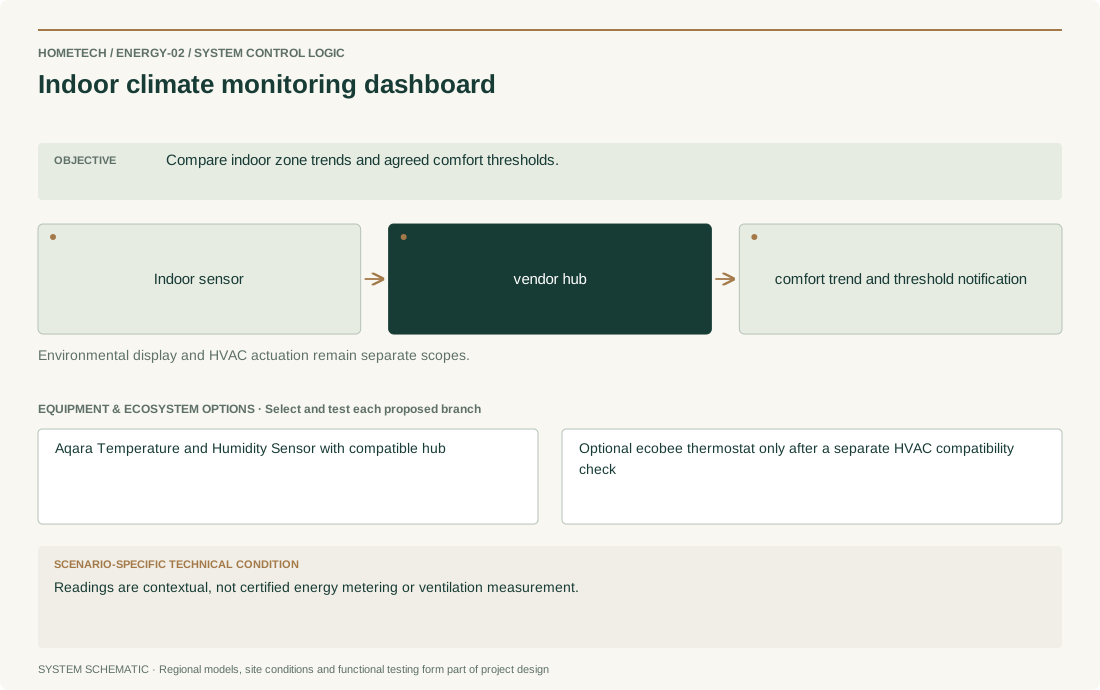
- Compare indoor zone trends and agreed comfort thresholds.
Recommended system architecture
- Indoor sensor → vendor hub → comfort trend and threshold notification
- Environmental display and HVAC actuation remain separate scopes.
Equipment & ecosystem choices
- Aqara Temperature and Humidity Sensor with compatible hub
- Optional ecobee thermostat only after a separate HVAC compatibility check
Installation & technical requirements
- Use a dry, non-condensing indoor position away from direct sun, heating outlets and water vapor; compare readings before selecting thresholds.
- Site acceptance focus: Compare indoor zone trends and agreed comfort thresholds.
Compatibility & construction constraints
- No medical, mold-detection, air-quality or emergency-monitoring claim. Humidity sensing does not measure CO2 or particulate matter.
- Readings are contextual, not certified energy metering or ventilation measurement.
Make it your own
- For indoor climate monitoring dashboard, confirm room/door/zone counts, agreed controls, notification recipients and installation stage.
- Specific decision: Readings are contextual, not certified energy metering or ventilation measurement.
Preliminary equipment plan
- One sensor per independently evaluated comfort zone; hub count follows tested coverage rather than floor area alone.
- Scale by the surveyed scope for indoor climate monitoring dashboard, not by a fixed package advertised without a site schedule.
What shapes the budget
- Zone count, placement access, notification recipients and whether independent HVAC control is requested.
- Country/city, labor, taxes, shipping, warranty route and confirmed supply source; no price or stock is assumed.