Who it’s for
- Retail & Showrooms
- US or Canadian project owners working with an appropriately qualified local installer
The project challenge
- A shade display should demonstrate controlled travel and a reachable stop.
What the system should achieve
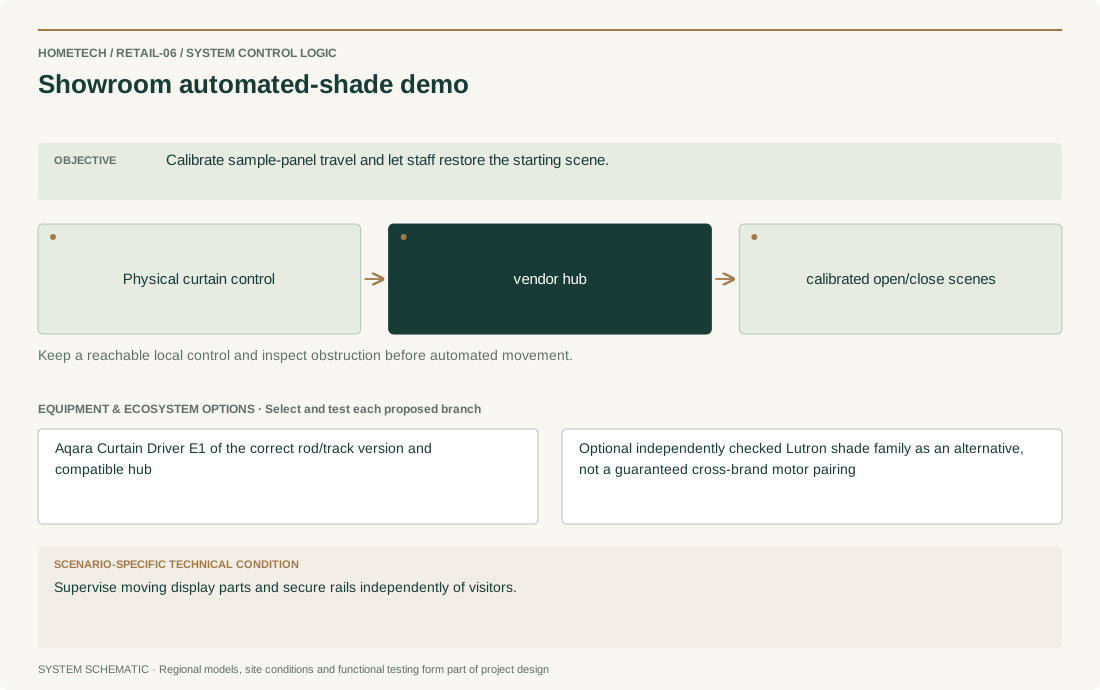
- Calibrate sample-panel travel and let staff restore the starting scene.
Recommended system architecture
- Physical curtain control → vendor hub → calibrated open/close scenes
- Keep a reachable local control and inspect obstruction before automated movement.
Equipment & ecosystem choices
- Aqara Curtain Driver E1 of the correct rod/track version and compatible hub
- Optional independently checked Lutron shade family as an alternative, not a guaranteed cross-brand motor pairing
Installation & technical requirements
- Measure rail geometry, curtain mass and travel friction; calibrate end positions and route charging cables safely.
- Site acceptance focus: Calibrate sample-panel travel and let staff restore the starting scene.
Compatibility & construction constraints
- E1 rod specifications exclude extendable rods; check exact rail version and manufacturer load limit. Test firmware and bridge exposure rather than assuming all Matter features.
- Supervise moving display parts and secure rails independently of visitors.
Make it your own
- For showroom automated-shade demo, confirm room/door/zone counts, agreed controls, notification recipients and installation stage.
- Specific decision: Supervise moving display parts and secure rails independently of visitors.
Preliminary equipment plan
- One driver per independently moving curtain panel; a center-opening pair generally needs two drivers; hub by verified coverage.
- Scale by the surveyed scope for showroom automated-shade demo, not by a fixed package advertised without a site schedule.
What shapes the budget
- Panel count, rod/rail changes, power access, curtain friction and reachable manual control.
- Country/city, labor, taxes, shipping, warranty route and confirmed supply source; no price or stock is assumed.