How the system comes together
bedside and path presence sensing (sense)
night-time low-level logic (control)
bedroom-to-bathroom path lighting (actions)
large-print guide and family notification agreement (operation).
What makes the delivery work
brightness and delay tuned to the resident's walking pace; never a sudden full-bright startle; manual control within reach of the bed.
Who it’s for
- Accessible & Aging-in-Place
- US or Canadian project owners working with an appropriately qualified local installer
The project challenge
- A resident needs a softly lit night route without a camera in private spaces.
What the system should achieve
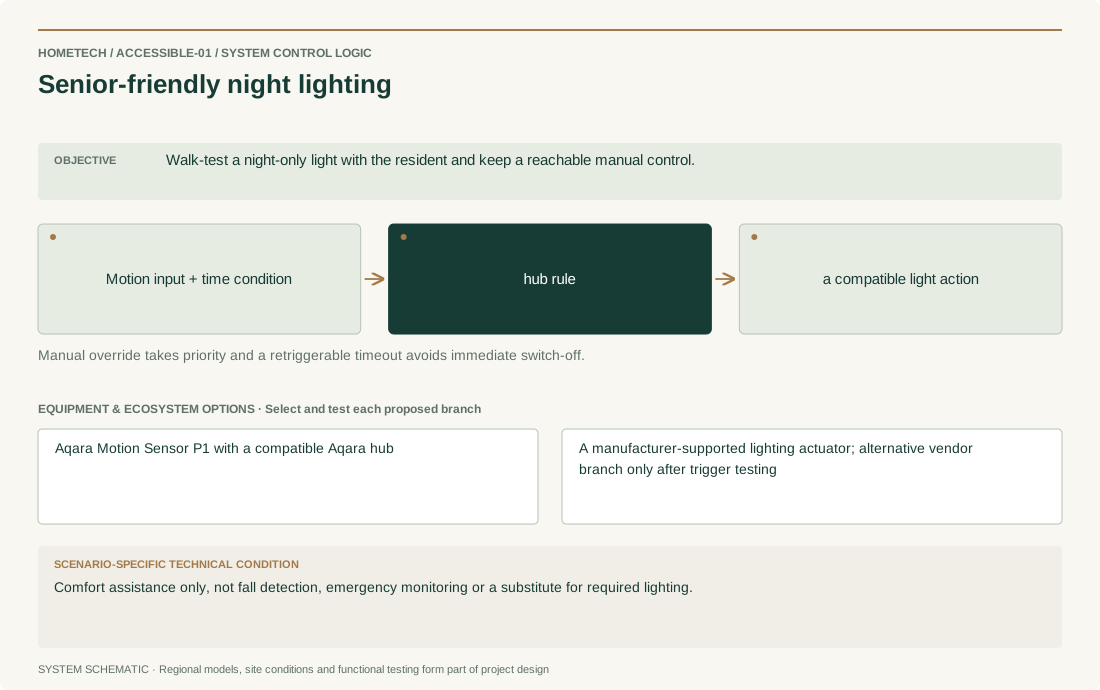
- Walk-test a night-only light with the resident and keep a reachable manual control.
Recommended system architecture
- Motion input + time condition → hub rule → a compatible light action
- Manual override takes priority and a retriggerable timeout avoids immediate switch-off.
Equipment & ecosystem choices
- Aqara Motion Sensor P1 with a compatible Aqara hub
- A manufacturer-supported lighting actuator; alternative vendor branch only after trigger testing
Installation & technical requirements
- Walk-test detection boundaries and approach directions; set mounting angle and timeout using the real route, not a product range maximum.
- Site acceptance focus: Walk-test a night-only light with the resident and keep a reachable manual control.
Compatibility & construction constraints
- PIR motion is not continuous occupancy or fall detection. Keep manual lighting and an independent safe baseline; confirm exact sensor/actuator hub support.
- Comfort assistance only, not fall detection, emergency monitoring or a substitute for required lighting.
Make it your own
- For senior-friendly night lighting, confirm room/door/zone counts, agreed controls, notification recipients and installation stage.
- Specific decision: Comfort assistance only, not fall detection, emergency monitoring or a substitute for required lighting.
Preliminary equipment plan
- One sensor per independently covered approach zone, adjusted after walk tests; one actuator per controllable lighting load; hub by tested coverage.
- Scale by the surveyed scope for senior-friendly night lighting, not by a fixed package advertised without a site schedule.
What shapes the budget
- Blind spots, approach directions, existing luminaires, actuator wiring and required manual controls.
- Country/city, labor, taxes, shipping, warranty route and confirmed supply source; no price or stock is assumed.